BLOG
Use of travertine (and other marbles or stones) in swimming pools
But is travertine a suitable material for a pool?
This is a very legitimate question, often asked by those choosing the finishing materials for their new swimming pool. The answer is yes, and it can be argued on both empirical and technical grounds.
Travertine is born in water. It is formed by the stratification of limestone deposits in springs particularly rich in this mineral: water is not an alien element to travertine; it is its natural habitat. Travertine quarries are always found in areas with abundant water.
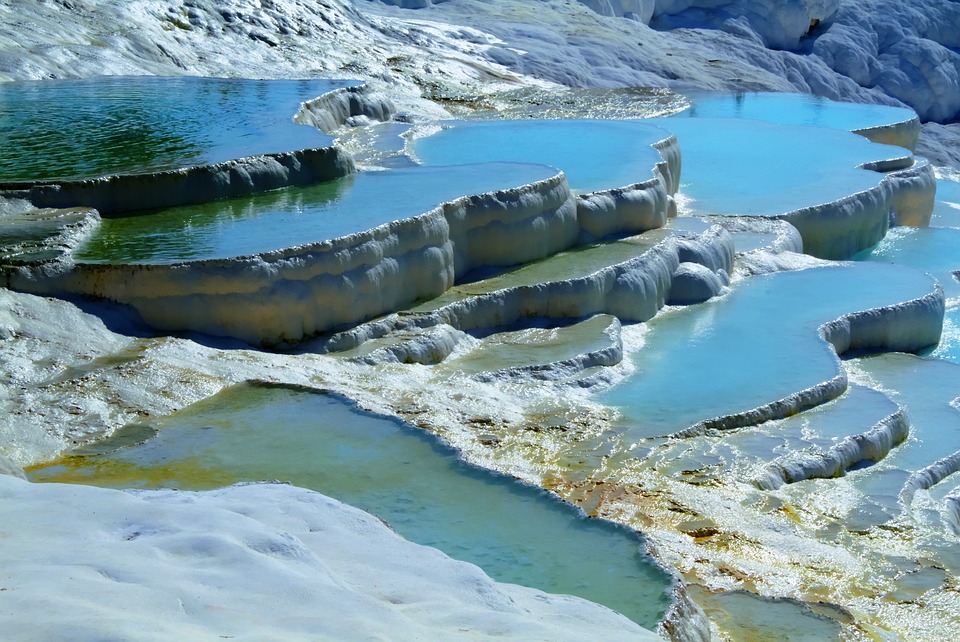
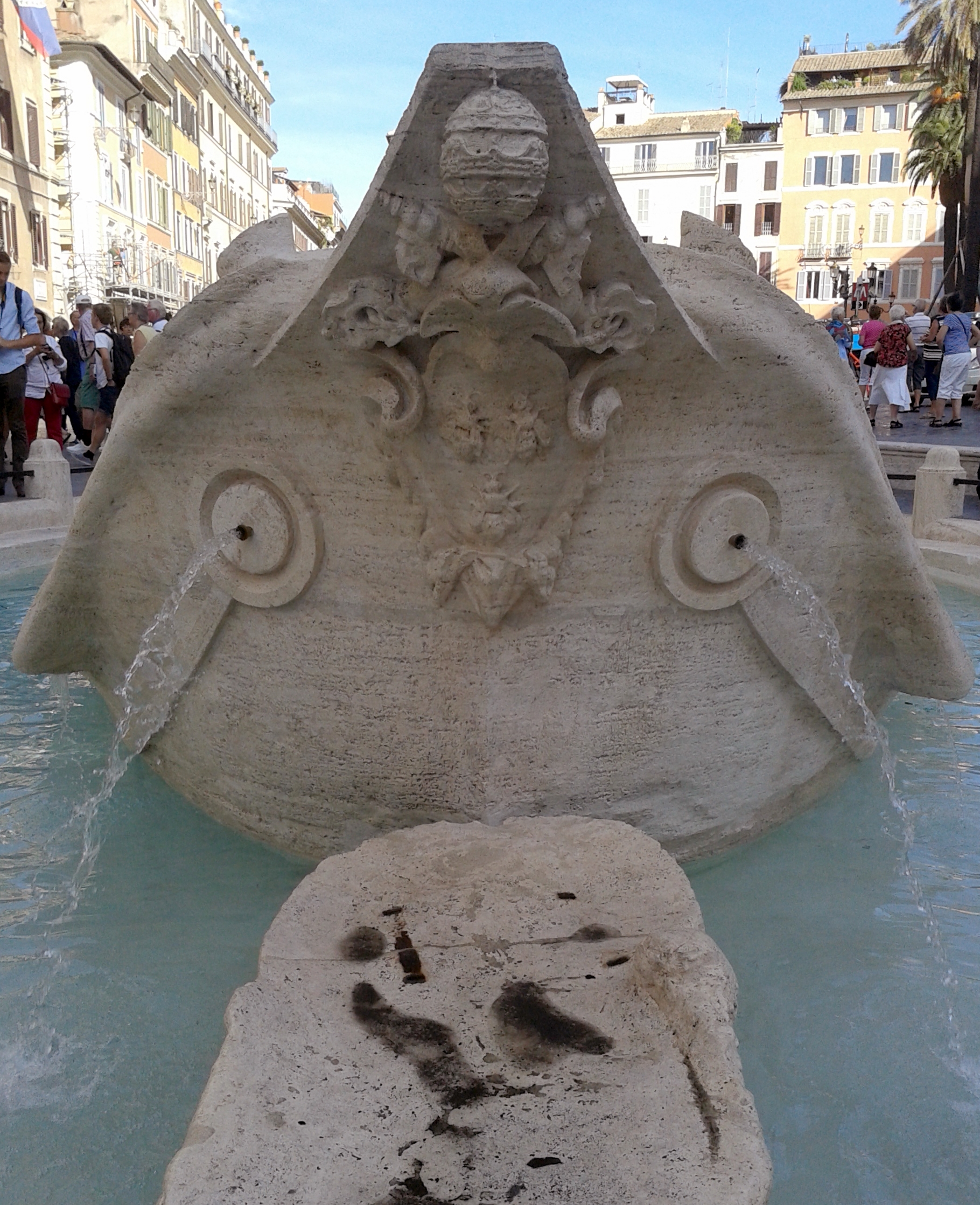
History confirms this alliance. Ancient Roman baths were largely made of travertine. Bernini’s Barcaccia, the Fountain of the Four Rivers, and the Trevi Fountain: these are all works that contain water, emerge from water, and are lapped by water. The baths of Saturnia and Rapolano, which can still be visited today, demonstrate that this stone coexists with water for periods that exceed the human scale.
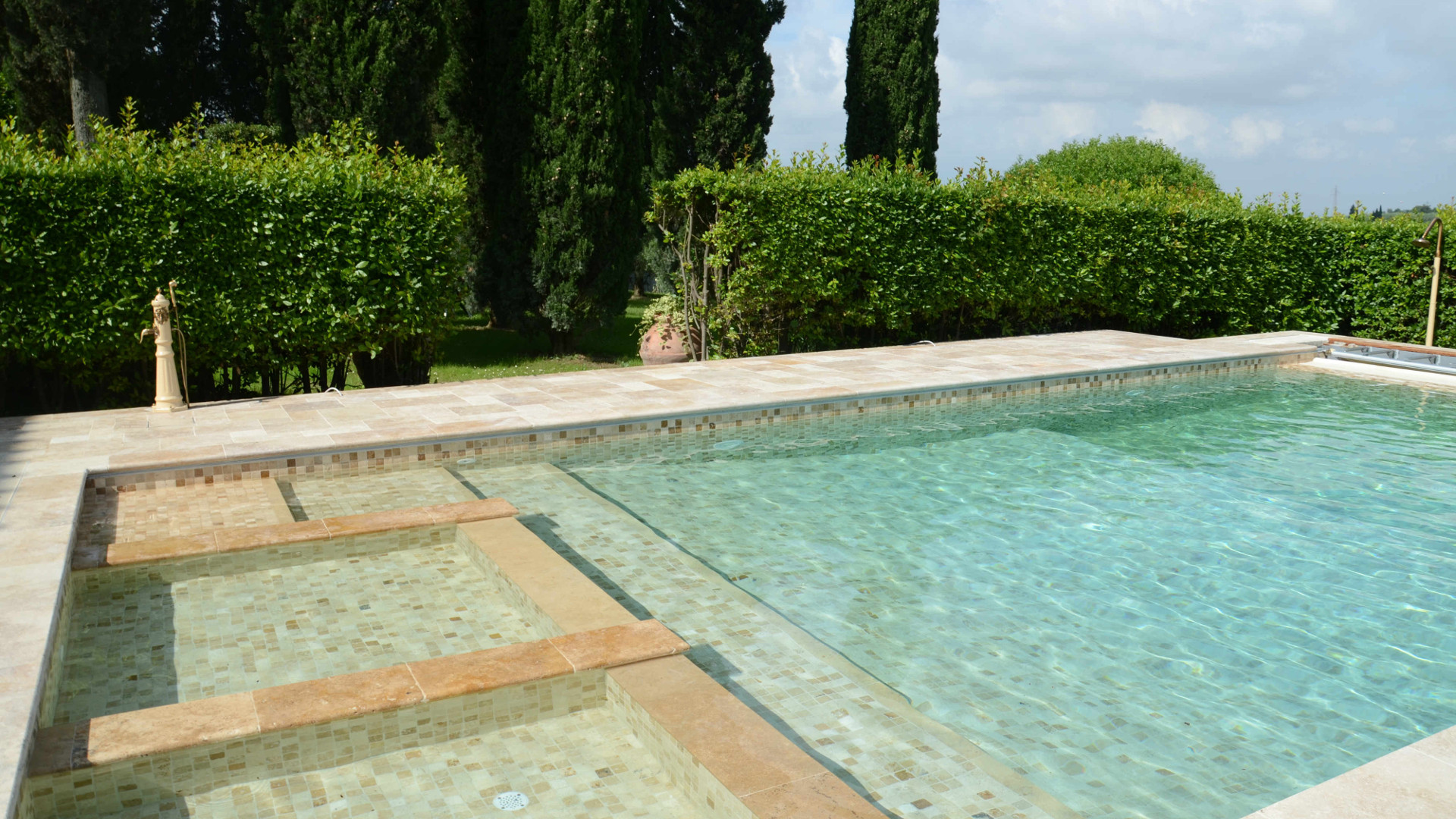
Travertine, marble, and limestone in general are perfect materials for swimming pools, basins, and any structure intended to contain water. The technical precautions to be adopted are few and are part of normal, good design.
The only true enemy: acid
Travertine, like most marbles and limestones, has only one aggressive agent: acid. It is not the treatment chemicals that deteriorate the stone, nor the chlorine, nor the algaecides: if dosed correctly, they are fully compatible. The only real threat is the acidity of the water.
Where the real risk arises
Understanding how pH behaves in a swimming pool is the prerequisite for managing it correctly. In a pool exposed to the sun and populated by bathers, the pH naturally tends to rise: the action of solar radiation and the organic residues introduced by bathers push the value upwards, day after day.
When the pH rises too high, chlorine and algaecides stop working. The water, having become too basic, begins to deteriorate and turn green. Faced with this situation, the widespread practice is the so-called shock treatment: a massive and concentrated injection of acid to quickly bring the pH back to operational values.
And it is precisely at that moment that the travertine is damaged. It is not the ordinary chemistry of a swimming pool that wears down the stone, but the reactive, concentrated, and periodic corrections that one is forced to make when pH management has not been continuous.
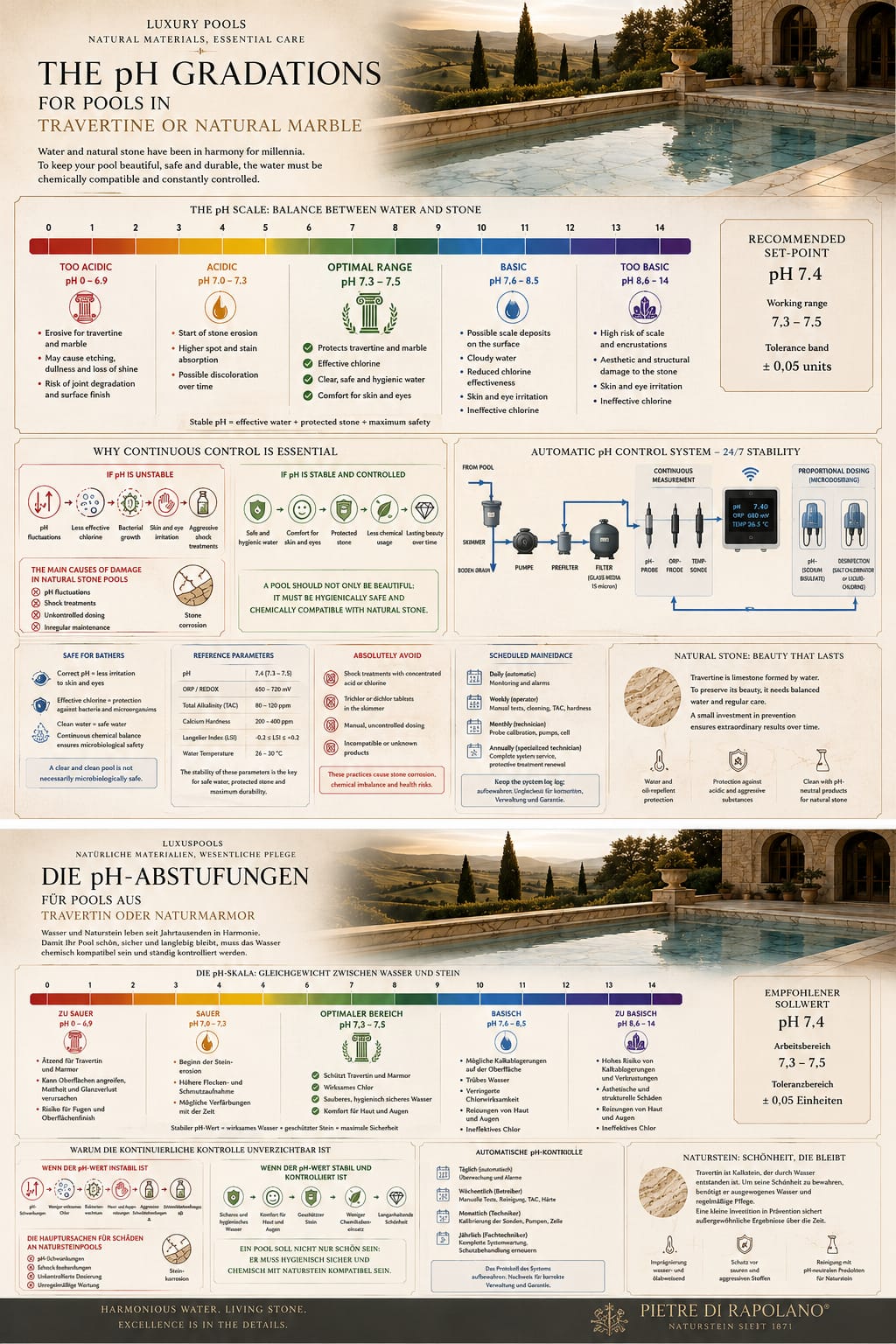
The solution: continuous control, not reactive correction
For this reason, a well-designed travertine pool is equipped with an automatic device that tests the water pH continuously and injects small doses of corrective agent whenever the value begins to drift. Replacing large periodic shocks with daily micro-dosages means two things: the stone never suffers concentrated acid attacks, and the water maintains a stable quality without the need for extraordinary interventions.
For designers, installers, and clients who wish to learn more about the operation of a purification and automatic pH control system calibrated for natural stone pools, we have prepared a complete technical document:
📄 Download the technical document — Purification and automatic pH control system (PDF)
Infinity pools: an extra consideration
Infinity pools, in which water overflows from one or more sides of the basin creating a continuous flow along the edge, introduce a second stress factor on the stone: the hydro-abrasive action of the flow. On a surface that is protected from a chemical point of view, this flow does not cause any problems. However, if the water is even slightly acidic, the two effects combine and amplify each other. For infinity pools, therefore, automatic pH control is not just a recommendation: it is an essential condition.